On product development cycles and priorities
I previously summarized the product development cycle briefly, but I rewrote it for internal use from a slightly more abstract level, removed confidential content, and am publishing it here.
1. First, what is a moonshot?
A moonshot is a grand plan, challenge, or goal that is extremely difficult and original, but would create major impact and innovation if realized.
A moonshot includes the positive element of believing in the possibility of an original idea, even when enormous costs and many obstacles stand in the way.
The term comes from the “moon shot” in the words of U.S. President John F. Kennedy in 1961, which became the trigger for the Apollo program: “before this decade is out, landing a man on the Moon and returning him safely to the Earth.”
2. Confirming our position
- A startup is a company that aims for rapid growth / a society that aims for 20% month-over-month growth.
- To create impact, it is essential to aim for a moonshot.
3. What to understand when aiming for a moonshot
- To aim for a moonshot, you need to understand and practice the quality and number of bats needed for one home run.
- It is not about increasing the number of swings and hoping for a home run.
- In other words, we need to focus on one ambitious goal and stack up high-quality improvements.
4. Core experience and the user experience design document
- A document that summarizes the information needed to realize one ambitious goal / something that shows the method for the company-wide vision.
The content is confidential, so it is not public.
- Execute every initiative in order to realize what is written in the core experience.
- Update the core experience continuously while executing.
- Accept questions and change proposals from team members broadly, and build it as shared understanding across the whole team.
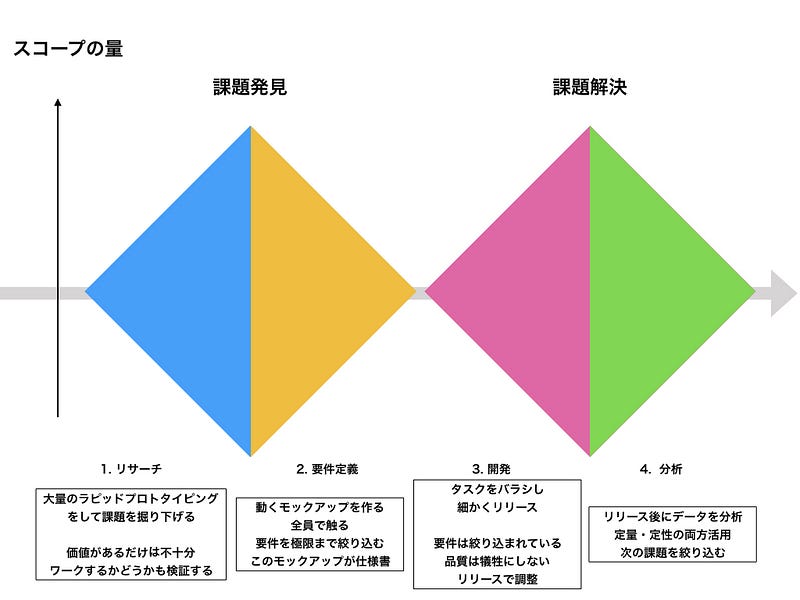
5. Development process for realizing the core experience
- Increase the number of initiative trials and raise the quality of the initiatives executed.
- Efficiently rotate the hypothesis-testing process.
- Premise 1: development members are basically extremely busy.
- Premise 2: adding features, or making the product multifunctional, lowers user experience.
6. Current sprint in progress
- Decide priority by comparing it with the core experience and the status of the sprint currently in progress.
The content is confidential, so it is not public.
7 . Exceptions
- Sometimes unavoidable issues occur, such as paying down technical debt or solving urgent problems.
- The answer to this is to run the sprint at 70% strength and use the remaining 30% to pay down debt.