How the education industry will change after 2020, or how it should change
A review of EdTech trends before 2020
Before summarizing what comes after 2020, I want to review the flow before 2020. I understand the pre-2020 flow as three major trends.
- From standardization to personalization
- Mastery learning
- MOOCs
From standardization to personalization
The shift from standardization to personalization is summarized in Clayton Christensen’s “Disrupting Class: How Disruptive Innovation Will Change the Way the World Learns.” In short, conventional education assumed the Industrial Revolution and was built around standardizing education for mass production in factories, but with changes in industrial structure such as startups, it becomes an age of personalized learning that can create differences from others, or added value.
- Standardization: the same educational content, for children of the same age, in the same classroom, at the same time.
- Personalization: the content people should learn, how they learn, when they learn, and the optimal method are each selected by the individual.
Disrupting Class _Amazon page for Clayton Christensen, Michael Horn, Curtis Johnson, and Yuko Sakurai._www.amazon.co.jp
As an aside, this view also predicts that because educational processes such as creating teaching materials, training teachers, teaching methods, and testing are too established, innovation in education will come from outside the education industry.
Mastery learning
For mastery learning, Salman Khan’s “The One World Schoolhouse: Education Reimagined” is detailed. Traditionally, even when students did not understand something, they had to move on. With technological progress, they can now fully master each unit before moving to the next.
Technology has the power to make education more portable, flexible, and personal, to nurture originality and personal responsibility, and to restore a sense of treasure hunting to the learning process. Khan says this in the book. Not only students in the United States, but children and adults on European street corners, in Indian villages, and in Middle Eastern towns where young women sometimes try to learn in secret, can learn through Khan Academy as long as they are connected to the internet.
https://www.amazon.co.jp/dp/4478020469
The point of mastery learning is the idea that whether someone can or cannot do something is not a difference in ability, but a result of not spending the right amount of time at the stumbling point. If we can solve that problem, there should be no dropouts in the world.
MOOCs
MOOCs stands for Massive Open Online Courses and refers to delivering lectures online. “Massive” feels a little exaggerated, but the point is that once lectures can be delivered online at large scale, meaning globally, anyone can become an instructor, and everyone can take classes from leading experts around the world.
For MOOCs, I think it is better to visit actual sites such as Coursera and edX and watch videos than to read books.
Coursera | Build Skills with Online Courses from Top Institutions _Join Coursera for free and learn online. Build skills with courses from top universities like Yale, Michigan, Stanford._coursera.org
edX _Gain new skills, advance your career, or learn something just for fun. EdX is a nonprofit offering 1900+ courses from._www.edx.org
The industry map before 2020
The above is the big flow of changes in learning methods. I will also briefly summarize what kinds of players, or companies, existed within that flow. It is easy to understand by looking at chaos maps, so I will cite them.
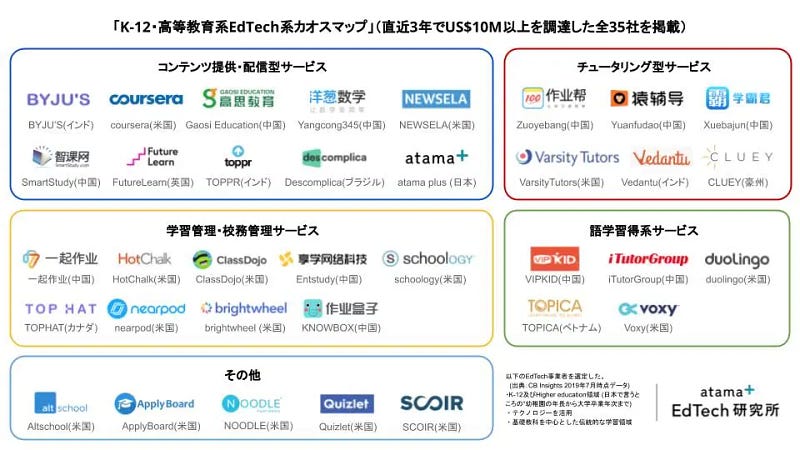
atama plus releases an EdTech chaos map and launches a research institute | TechCrunch Japan _atama plus released atama plus EdTech Research Institute, providing latest trends and data in global EdTech._jp.techcrunch.com
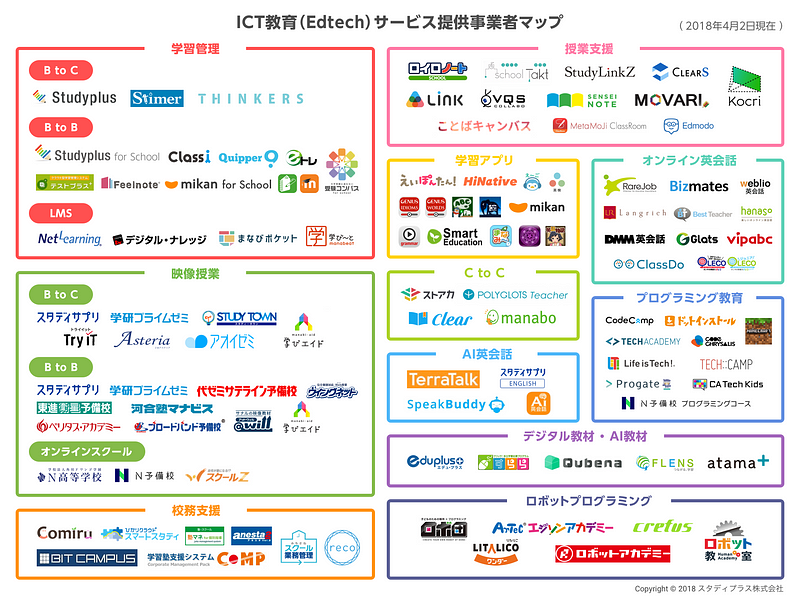
ICT education, EdTech service provider map update | Studyplus Inc. _We will continue updating this map regularly._info.studyplus.co.jp
Later, when discussing the flow after 2020, I will summarize it in another way, but “infrastructure,” “content,” and “tutoring” can be considered the large groupings.
On coaching
This is a slight detour, but I will also touch on trends in coaching. The book “Trillion Dollar Coach: The Leadership Playbook of Silicon Valley’s Bill Campbell,” published last year, became a major topic. Coaching also seems to be gaining momentum.
https://www.amazon.co.jp/dp/B07ZCY5BXF/
However, I did not include coaching in the three major trends above. From my personal view, coaching has recently become a topic, but it was originally an extension of ideas from Maria Montessori, and the idea of coaching is separate from recent technology-driven innovation. I will also mention Maria Montessori later when introducing Marc Andreessen’s article.
So, did education innovate?
My personal answer is no. Conventional standardized education continues, dropouts have not disappeared, and educational inequality only keeps widening. Until 2020, I answered the question of why educational innovation has not happened in the following way.
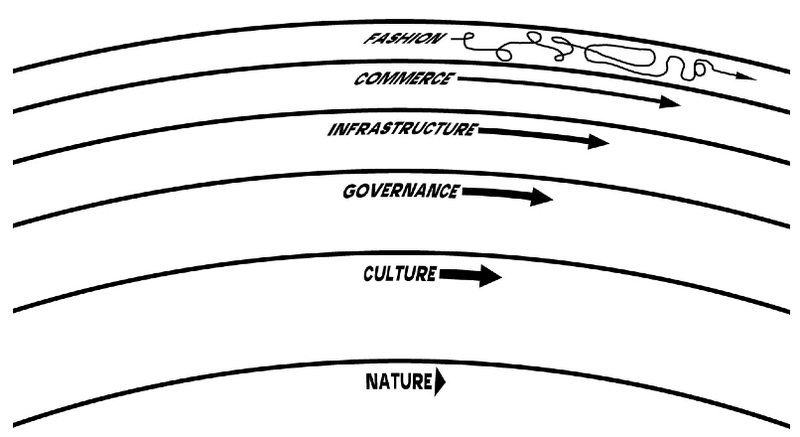
https://jods.mitpress.mit.edu/pub/issue3-brand
This is a diagram from the English article “Pace Layering: How Complex Systems Learn and Keep Learning.” It summarizes how each layer changes at a different speed. Education is positioned as infrastructure, so the speed of change is slower than in areas such as e-commerce. My answer was that it will eventually change, but it will take time.
And then coronavirus came
This section is a little emotional. You can skip it.
While thinking about those things, the coronavirus pandemic happened. Marc Andreessen published the post below. It hit me hard.
IT’S TIME TO BUILD
IT’S TIME TO BUILD _Every Western institution was unprepared for the coronavirus pandemic, despite many prior warnings._a16z.com
As an aside, the thing that personally made me fascinated by the internet was also Marc Andreessen’s “Why Software Is Eating The World.” https://www.wsj.com/articles/SB10001424053111903480904576512250915629460
Here are quotes from the article.
Every Western institution was unprepared for the coronavirus pandemic, despite many prior warnings. This monumental failure of institutional effectiveness will reverberate for the rest of the decade, but it’s not too early to ask why, and what we need to do about it.
Many of us would like to pin the cause on one political party or another, on one government or another. But the harsh reality is that it all failed — no Western country, or state, or city was prepared — and despite hard work and often extraordinary sacrifice by many people within these institutions. So the problem runs deeper than your favorite political opponent or your home nation.
Part of the problem is clearly foresight, a failure of imagination. But the other part of the problem is what we didn’t *do* in advance, and what we’re failing to do now. And that is a failure of action, and specifically our widespread inability to *build*.
I will also paste the DeepL translation.
Despite many prior warnings, all Western institutions were unprepared for the coronavirus pandemic. This monumental failure of institutional effectiveness will echo through the rest of this decade, but it is not too early to ask why, and what we should do.
Many of us want to blame one political party or another, one government or another. But the harsh reality is that everything failed. No Western country, state, or city was prepared, despite the hard work and often extraordinary sacrifice of many people inside those institutions. In other words, the problem is deeper than your favorite political opponent or your own country.
Part of the problem is clearly foresight, a lack of imagination. But the other part is what we did not do in advance, and what we are failing to do now. It is a failure of action, specifically our widespread inability to build.
Translated with www.DeepL.com/Translator free version.
It says Western society here, but Japan is probably the same. I strongly feel that the problem is that we knew this is how things should become, but we had not executed.
Here is the passage on education.
You see it in education. We have top-end universities, yes, but with the capacity to teach only a microscopic percentage of the 4 million new 18 year olds in the U.S. each year, or the 120 million new 18 year olds in the world each year. Why not educate every 18 year old? Isn’t that the most important thing we can possibly do? Why not build a far larger number of universities, or scale the ones we have way up? The last major innovation in K-12 education was Montessori, which traces back to the 1960s; we’ve been doing education research that’s never reached practical deployment for 50 years since; why not build a lot more great K-12 schools using everything we now know? We know one-to-one tutoring can reliably increase education outcomes by two standard deviations (the Bloom two-sigma effect); we have the internet; why haven’t we built systems to match every young learner with an older tutor to dramatically improve student success?
I will also paste the DeepL translation.
You can see it in education. We have top universities, but every year there are 4 million 18-year-olds in the United States and 120 million 18-year-olds in the world, and only a tiny fraction can be taught by those universities. Why not educate every 18-year-old? Isn’t that the most important thing we can do? Why not build far more universities, or scale the universities we have? The last major innovation in K-12 education was Montessori, dating back to the 1960s. For 50 years since then, we have conducted educational research, but it has not reached practical deployment. We know that one-to-one tutoring can reliably improve educational outcomes by two standard deviations, the Bloom two-sigma effect.
www.DeepL.com/Translator free version.
The last major innovation in K-12 education was Montessori
Exactly. Since Montessori, up to 2020, we have not created educational innovation and have not been able to change the existing form of education. Because of that, we have reached a point where it is almost impossible to deliver education. I think we should reflect deeply on this.
After 2020, we need to respond to this issue urgently. I think we truly have to realize the society of deschooling that Ivan Illich wrote about in 1977.
I suddenly brought up Ivan Illich, but the ideas of personalization, mastery, and MOOCs had already been considered in 1977, before the Web was released in 1989. And I think again: technology does not drive evolution. Human will drives evolution, and technology realizes it. It may feel like an old text, but if you are interested, please read it.
Deschooling Society _Amazon page for Ivan Illich’s Deschooling Society._www.amazon.co.jp
The world after 2020
Before thinking about education after 2020, I want to grasp the overall sense of what the world after 2020 will become.
There are two articles I want to introduce. The first is a post-pandemic forecast summarized by the UK’s NESTA, the National Endowment for Science, Technology and the Arts. It is not directly about education, but it predicts what the world as a whole might become. Please treat it as reference. You can also skip it.
I will quote each point and add personal comments.
NESTA, the UK’s National Endowment for Science, Technology and the Arts
Politics
- The range of politically acceptable policies expands and harms the structure of liberal democracy.
- Globalization retreats while nationalism grows.
→ We need to search for ways to protect both safety and freedom, and to cooperate among nations.
Economy
- The recession caused by the pandemic is very likely to be far worse than the financial crisis.
- Failures of indebted companies and banks may mean a revived movement toward transparent digital currencies and tokens.
- Internationally and domestically, supply chains are being rapidly reconfigured, and business models are also changing rapidly. This also means that many jobs that disappeared during the pandemic will not return.
→ We need to reconsider what capitalism should be.
→ Survival problems caused by economic problems must be addressed urgently.
→ Whole industries may change. If you are in an industry that disappears, a company-survival perspective will not be enough.
Society and culture
- Short-term attention focused on the bottom layer of Maslow’s hierarchy may prompt society to re-evaluate what it cares about most. For example, it may raise the relative status of medical workers and agricultural workers, and weaken “luxury” industries including leisure, games, and arts, though history suggests this may be short-lived and the luxury status of some goods and services may eventually be reinforced.
→ Cultural things may decline.
Technology
- The relative success, or failure, of a science-led approach may further strengthen, or weaken, public trust in science and expert opinion.
→ I do not know whether the growing power of technology and science is good or bad. At the same time, I feel that the power of religion, which may appear to oppose it, will also grow.
Legal
- Many companies are citing force majeure or acts of God as legal defenses for not fulfilling contractual obligations.
- Because China is trying to patent treatment methods, the patent system may come under stricter scrutiny, and intellectual property rights are being blamed for blocking access to key medical devices such as ventilators.
→ I think the existing legal framework will clearly reach its limits. Copyright was already difficult before 2020.
Environment
- The decline in economic activity has sharply reduced global greenhouse gas emissions.
- Food security will become a concern in many countries, and cultures that eat exotic mammals will be questioned.
→ There are good and bad aspects. If this becomes prolonged, securing food is likely to become a major issue.
It is about time to hear a view of the whole picture, part 2
https://kaz-ataka.hatenablog.com/entry/2020/04/04/190643
The second article is an analysis by Kazuto Ataka, who wrote “Issue kara Hajimeyo” and “Shin Nihon.” After reading the NESTA analysis, reading Ataka’s article helps understand what background he is writing from.
This analysis is directly useful when thinking about education in 2020. The very important figures are below.
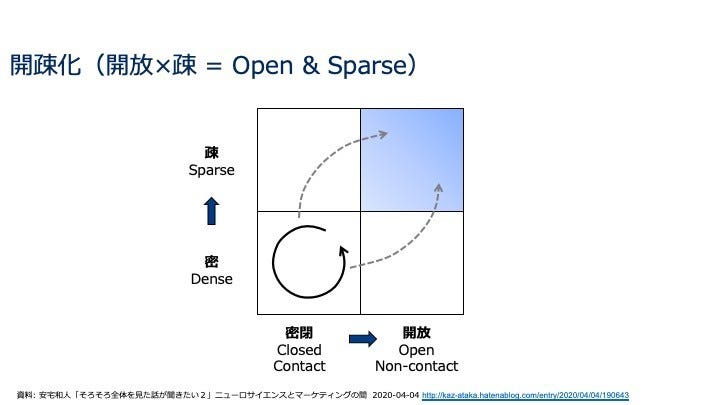
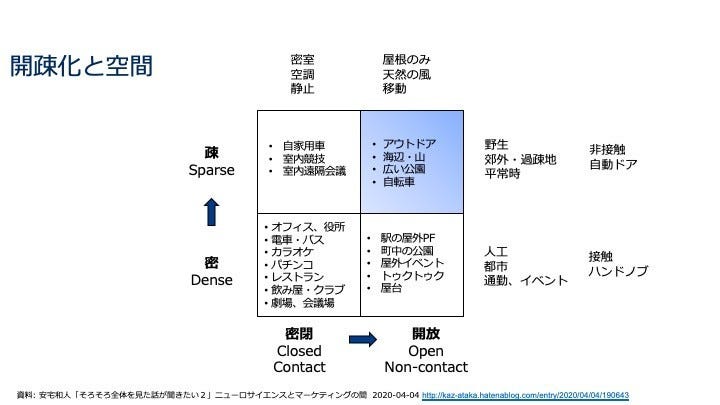
Since the Industrial Revolution, people have increased productivity by gathering together. In the large flow, they have moved toward the lower-left area. After that, the information industry emerged and tried to move toward the upper-right area, but the gravity of existing industries was strong and the shift could not happen. That is an easy way to understand it.
People developed by creating cities.
You can get a sense of this by reading Jacques Attali’s “A Brief History of the Future,” though it is a slightly old book.
https://www.amazon.co.jp/dp/4861821959
For example, even if the technology industry has promoted the upper-right area, its center was Silicon Valley. It created a city, gathered densely in the lower-left area, sometimes with secrecy, and created innovative services and products.
Now, I think the world is entering a situation where we must seriously shift our footing to the upper-right, sparse and open area.
What education should be after 2020
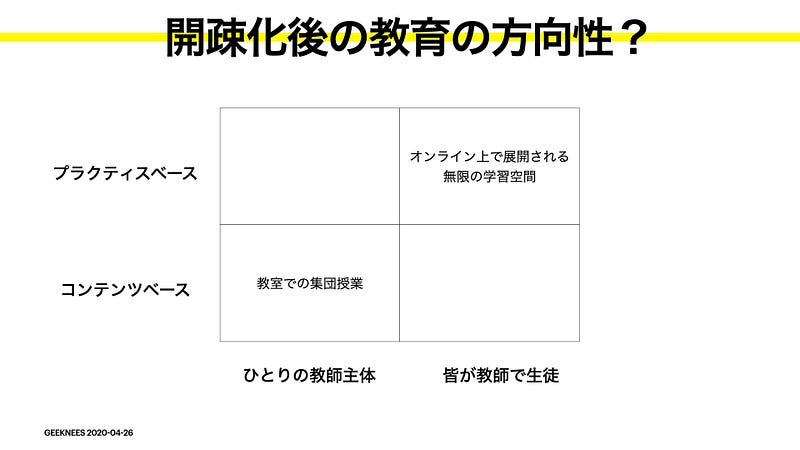
This is based on Ataka’s matrix of becoming open and sparse. The idea is that we used to be in the lower-left, but now we have to go to the upper-right.
The clearest example of the lower-left is the National Center Test for University Admissions. In the post-corona, or with-corona, world, I really cannot think it is right for everyone to gather in the same place, at the same time, take the same test, and be judged by the result.
Of course, I understand that it was a relatively fair system with relatively little inequality. But with school classes delayed by the effects of coronavirus, and probably economic inequality growing as well, I do not think the Center Test can be held with the same fairness as before.
Content-based / dense and practice-based / sparse, the vertical axis
In the section on the industry map before 2020, I wrote “infrastructure,” “content,” and “tutoring.” Infrastructure is a common foundation, so I think the education industry can broadly be rephrased as “content-based” and “practice-based,” meaning tutoring. For example, reference books are content-based, and cooking classes are practice-based.
Thinking from the form of the National Center Test, I think practice-based learning, such as actually making something, will be valued more in the future than content-based learning built around common exams.
It will still be necessary to learn content in order to practice. But the order should be practice → content, and I think we should stop evaluating the results of content acquisition itself. If people cannot receive education now, how many of them are opening reference books and studying?
At the same time, practice is not automatically enough. I think the reason practice-based education could not overcome content-based education is that outcomes cannot be measured. The result of practice is making something. Unless the practice produces outputs that can be objectively evaluated, the shift seems difficult.
One teacher-led / closed and everyone is teacher and student / open, the horizontal axis
When gathering in daily life becomes difficult, we can no longer depend on the existence of one teacher. Until now, parents were probably teachers at home, and friends were teachers during play. I think promoting such environments will help maintain learning opportunities.
Of course, during trials it may be necessary to some extent, but under these circumstances, is it effective for teachers at each school to record and distribute similar classes based on the curriculum guidelines at each school?
Careful discussion is necessary, but perhaps removing the boundary of school districts, having members with the same interests gather online without boundaries of teacher, student, or grade, and exchanging information with each other would deepen learning. In that form, we may be able to maintain learning opportunities.
How education should change after 2020
After making these divisions, I will think again about how the education industry will change. It is not that different from the pre-2020 trends of “from standardization to personalization,” “mastery learning,” and “MOOCs.”
On the other hand, what has become more important is the need to move quickly, and the possibility that we can break institutions that have become constraints in order to do so.
To deliver education to people who can no longer receive it, there is a possibility that people will accept changes mainly in politics, culture, and customs. Thinking about what constraints we should break in order to realize practice-based N:N education more quickly may become the first step for education after 2020. It may produce better ideas than the 2020 education reform or the new curriculum guidelines.
Finally
I have written at length, but I believe the future cannot be predicted. This article assumes that the coronavirus problem will be prolonged, but it may be solved unexpectedly quickly, which would be welcome.
In any case, it depends on what future we choose under the conditions we are given. That is why the title is not only “how it will change,” but “how it will change, or should change.” I want to keep working hard to create a better future.
I wrote down what I had been thinking recently, but the discussion wandered in many directions. It includes personal opinions, and I may have misread some things. If there is criticism, I would appreciate it if you pointed it out so I can correct it.
The best way to predict the future is to invent it.
Alan Kay