It has been a while since I bought a fixed-gear bicycle
Since my children are getting older and there will be less reason to use a child-carrying bicycle, I bought a fixed-gear bicycle. This is a record of what kind of bicycle I bought and what customizations I made.
I first considered buying a cross bike because I wanted to ride a sport bike. In the end I chose a fixed-gear bicycle because I had long been interested in the street culture close to piste bikes and knew I would eventually want to try one anyway.
Choosing the bicycle
At first I looked casually on Amazon. I learned that for a steel bike, a chromoly frame is good, and while researching parts I noticed that Amazon listings rarely explain the parts configuration.
I then found a bicycle called bruant, available on Rakuten for under 40,000 yen. I also looked at higher-end options such as Surly’s Steamroller, starting around 250,000 yen.
Eventually I found that DINER’s private-brand CARTELBIKES Avenue was on sale for under 50,000 yen. The size was slightly large, and ideally one buys smaller if unsure because parts can adjust it, but it was within tolerance, so I bought it.
Through this research I learned about domestic fixed-gear bike shops, their positions, overseas frame builders, and OEM production in Taiwan and China. The large price differences come from both parts precision and branding. The appeal of fixed-gear bicycles is that they can be customized freely. I wanted to express my own taste as much as possible, so I chose to customize it myself.
bruant seemed capable enough for tricks, but I learned it would be inconvenient to customize. For example, seatposts are often 27.2 mm, while bruant uses 25.4 mm, which narrows the custom options.
I also thought about why half-price sales were happening. The bicycle industry had the waves of COVID-era demand and the rise of electric bicycles. Demand rose, inventory increased, then a supply-demand gap appeared. Some shops also shifted business toward electric bikes. I probably happened to buy in that gap.
Because bicycles are not consumables that sell constantly, the business structure itself was interesting to me. It is not simply a business where selling more units or more custom parts is always enough. In general, I still think it is better to buy from a specialized bike shop. Some shops have a street feel, while others translate bicycle culture into something highly stylish. It is probably best to buy from a shop whose values match your own. In my case, I was not especially aligned with one specific shop’s values, so I prioritized price and quality.
First customizations
I bought some parts on Mercari and Yahoo Auctions, trying to choose inexpensive but high-quality parts. For drivetrain parts, I preferred new parts.
- Pedals: MKS Sylvan Gordito, 4,350 yen
- Pedal straps: around 2,000 yen from Amazon
- Light
- Pump: Panaracer with pressure gauge
- Lock: PALMY U lock
- Side stand
Pedal straps are almost essential for fixed gear, so I changed the pedal area at the same time. Better pedal rotation slightly reduces friction while pedaling. This is where I started getting hooked on customization: when you change a part, you can feel the change. Then you get used to it and want another change.
The interesting thing is that after changing pedals, I could notice poor pedal rotation when riding other bicycles. It felt like developing a new bodily sense. I considered not using a side stand because it does not look cool, but when moving with family it is often necessary, so I installed one. I chose something that could be attached roughly and removed all the strange logo stickers that came with it.
At first, because it was my first sport bike, I rode it as free gear. Two days later I wanted to try fixed gear and switched. I became hooked on the direct feeling of being connected to the ground.
Replacing the pedals and flipping the rear wheel between the free-gear side and fixed-gear side can be done with one 15 mm wrench. Since the chain tensioners are 10 mm, it is also useful to have an adjustable wrench.
Cog, chainring, handlebar, seatpost, and tires
The first part I changed was the cog. The stock cog was 18T, but I wanted more skid points, so I changed it to 17T. With 46T front and 18T rear, there are 8 skid points; with 46T and 17T, there are 17. Because 17 is prime, the skid points increase dramatically. This mathematical aspect is also fun.
I bought a new grunge cog for about 5,000 yen and the necessary tools. Comparing it with the stock cog showed the precision difference. I decided my custom policy: replace low-precision complete-bike parts, but do not always choose the most expensive option. I like finding the best cost-performance point between the cheapest and the best.
EURO ASIA cogs are famous, but depending on the grade they cost two to four times as much. I first bought the grunge cog as a trial. The stock cog worked, of course, but the edge finishing and polishing were rough. Looking on AliExpress, I found what seemed to be almost the same kind of cog for around 1,000 yen. In other words, I think these are the kinds of places where complete bikes reduce cost to provide an accessible bicycle.
Changing from 18T to 17T made the pedal feel slightly lighter. The improved gear precision may have been partly psychological, but the chain seemed to flow more smoothly. Around this point my custom policy became clear: replace the lower-precision complete-bike parts, but do not choose the very best part every time. Choose something with appropriately good quality.
There is a tendency in how I approach hobbies, or maybe life itself: between the very best thing and the cheapest thing, there is usually a spot with the best cost performance. I like looking for that spot. If you can find the zone that feels just right and works well, everyone becomes happier.
I then learned seriously about NJS, the Japanese keirin standard, and bought a lightly used Shimano Dura-Ace chainring on Mercari. The precision of NJS parts was very high. The difference in feeling was subtle, but the chain tension felt more even and the satisfaction was high.
Before that, I first bought a Sugino chainring on Mercari, but the PCD, the size related to the crank-arm bolt circle, did not fit, so I returned it. The listing said PCD144, but what arrived was PCD130. The seller handled the return smoothly. Mercari’s anonymous shipping is very well designed when buying, but returns cannot use anonymous shipping, so the other party learns your address. That felt a little inconvenient.
The Dura-Ace chainring was also 46T, the same size as the original. A new Dura-Ace chainring costs around 15,000 yen, while the one I bought on Mercari was around 3,000 yen. It felt somewhat risky, but if there were a problem I could simply go back to the original chainring, so I tried it. I cannot say there was a dramatic difference when starting to pedal, but there was satisfaction in having a high-precision part installed. The chain tension also felt more even. If I had paid 15,000 yen, I might have regretted it.
For the handlebar, I chose a Nitto stem and B809 CROSS handlebar, partly because of the influence of MASH and partly because I wanted to use Japanese parts. For the seatpost, I chose Shimano PRO LT with zero offset. The handlebar felt clearly stiffer, and the seatpost made the road reaction more direct.
While researching fixed-gear information, I learned about MASH, the San Francisco team that influenced the global piste-bike scene. It overlapped with skateboard videos I watched more than twenty years ago, so maybe I had encountered it before. What interested me about the piste-bike scene is that Japan and Japanese manufacturing are highly respected. That made me want to use parts connected to MASH while also leaning toward Japanese parts, both out of respect for Japan and because of the weak yen.
The bike uses a threaded stem, so I chose a Nitto stem and the B809 CROSS handlebar in the compatible 25.4 mm size. I chose B809 because Mike Martin, the creator of MASH, is known to use it. Now that I am over forty, something loudly saying “MASH!” would feel a little too much, but this kind of understated part felt good.
For the seatpost, I wanted a zero-offset model to adjust the frame size. I did not clearly feel the frame was too large, but I was curious what would happen if I changed it. The original seatpost clamp also looked a bit like a hammer and did not look cool. I wanted to match it with Nitto, but that would cost over 10,000 yen, so I chose Shimano PRO LT in 27.2 mm. Around here I began to understand the difference between Nitto as a quiet, refined Japanese brand and Shimano as the huge player in the bicycle industry.
After changing the parts, the feeling changed clearly. The handlebar felt more rigid. Even when putting body weight on it, it felt solid, and I could lean forward with confidence. It surprised me that humans can feel the hardness of metals such as steel and aluminum. Looking closely at the pipes, the stiffer handlebar was actually thinner, which also showed the difference in part quality. The seatpost increased the direct reaction from the ground to my body. At first it was closer to discomfort, but I thought it might help me practice how to ride the bike, so I left it as is. Now I do not notice it at all, and personally I think a straight seatpost looks cleaner.
The stock tires were KENDA 23c. I wanted more comfort and grip, so I researched Continental Gatorskin, Panaracer Agilest, GravelKing, and Vittoria Randonneur Tech. In the end I tried CHAOYANG Attack Pard in 28c because it was inexpensive and had good durability and rolling performance. The ride became much more supple.
The original 23c KENDA tires felt like lumps of rubber. I had read that changing tires changes the feeling quite a lot, so I became interested. A 23c tire felt a little too narrow, and I worried about slipping, though I got used to it as I rode more. When choosing tires, I learned to look at price, grip, weight, rolling performance, and durability. Satisfying all of these makes tires expensive. CHAOYANG Attack Pard cost only around 2,000 to 3,000 yen per tire, but seemed to have good durability and rolling performance and was reasonably light, so I decided to try it first as a consumable.
I had already decided to move to 28c. The purpose was to improve ride comfort and grip. The result was a dramatic change to a much more supple ride. It may be unfair to compare directly with the original KENDA tires, but even though I changed from 23c to 28c, the lightness and rolling performance also seemed better. Durability has been good even after a fair amount of skidding, which I appreciate. After a few months, however, I started to see slight cracking on the side skin. It is minor, so I am watching it for now, but if the cracks grow, I will need to replace them. I may choose the same tire again for the cost performance, or I may try something else. If I try something else, I want to go into the higher price range, perhaps around Gatorskin.
Removing the free gear, saddle, crank, and BB
After someone told me the unused free gear should be removed, I bought the tool and removed it. Surprisingly, the ride changed. Removing around 150 grams from the rear wheel mattered more than I expected.
Customization is dangerous because once you start, it does not stop. After changing the tires I had calmed down for a while, but then an acquaintance said, “This bike feels good, but you should remove that free gear.” Removing it required a dedicated tool, and I had assumed it would not matter much if it stayed on. But after removing it, the ride changed more than expected. A 150 g part attached to the rear wheel, where weight matters, seems to have a real effect. I am glad I removed it, and I recommend removing unused free gears if you have one.
I also replaced the saddle with a fabric Scoop Flat, changed the crank to an Andel crank found on Yahoo Auctions, and replaced the bottom bracket with a Tange LN7922. The BB replacement was difficult, but doing the work myself is part of the fun because I can feel how each change affects the bike.
I had wanted to replace the saddle because the ride was not especially comfortable, but honestly my butt did not hurt that much, so the original saddle stayed for a while. As other basic parts kept changing, I wanted to change it too, and chose a fabric Scoop Flat. It was listed on Mercari as an Elite model, and from the look of it the rails seem like titanium. The ride became better. The Flat model is described as an aggressive model with thinner padding, but it still feels more comfortable than before. I am satisfied, although the saddle was not the biggest problem to begin with.
The crank is an expensive part. A Sugino piste crank costs around 70,000 yen. I was bothered by still using the complete-bike crank, and I had learned that Andel cranks are used for bike-shop OEMs and on some All-City piste bikes, so they seemed good. Overseas they sell for around 100 to 200 dollars. I was not sure whether the effect would be real, and when I asked ChatGPT it said there would not be much effect for city riding, so I accepted that for a while. Then I happened to find an Andel crank and chainring set on Yahoo Auctions, with only the crank unused, and won it for around 5,000 yen.
I also wanted to replace the BB when changing the crank. The complete-bike BB seemed to be a roughly 1,000 yen part available on AliExpress, so I wanted to change it, though in practice it may not have been that bad. A good Tange BB can be bought new for around 6,000 yen. Tange has the LN3922 around 3,000 yen and the LN7922 around 6,000 yen, and for that difference I thought I might as well choose the better one.
The result was a much lighter pedaling feel. The crank length changed from 170 mm to 165 mm, which should not itself make pedaling lighter, so I think the BB performance and crank weight made the difference.
The BB replacement was honestly difficult, but I managed it. I know there is also the option of taking custom work to a shop, but basically I do it myself. The fun is feeling how the specific point I changed affects the bicycle.
Current state and the appeal of fixed gear
Here is the current bicycle.
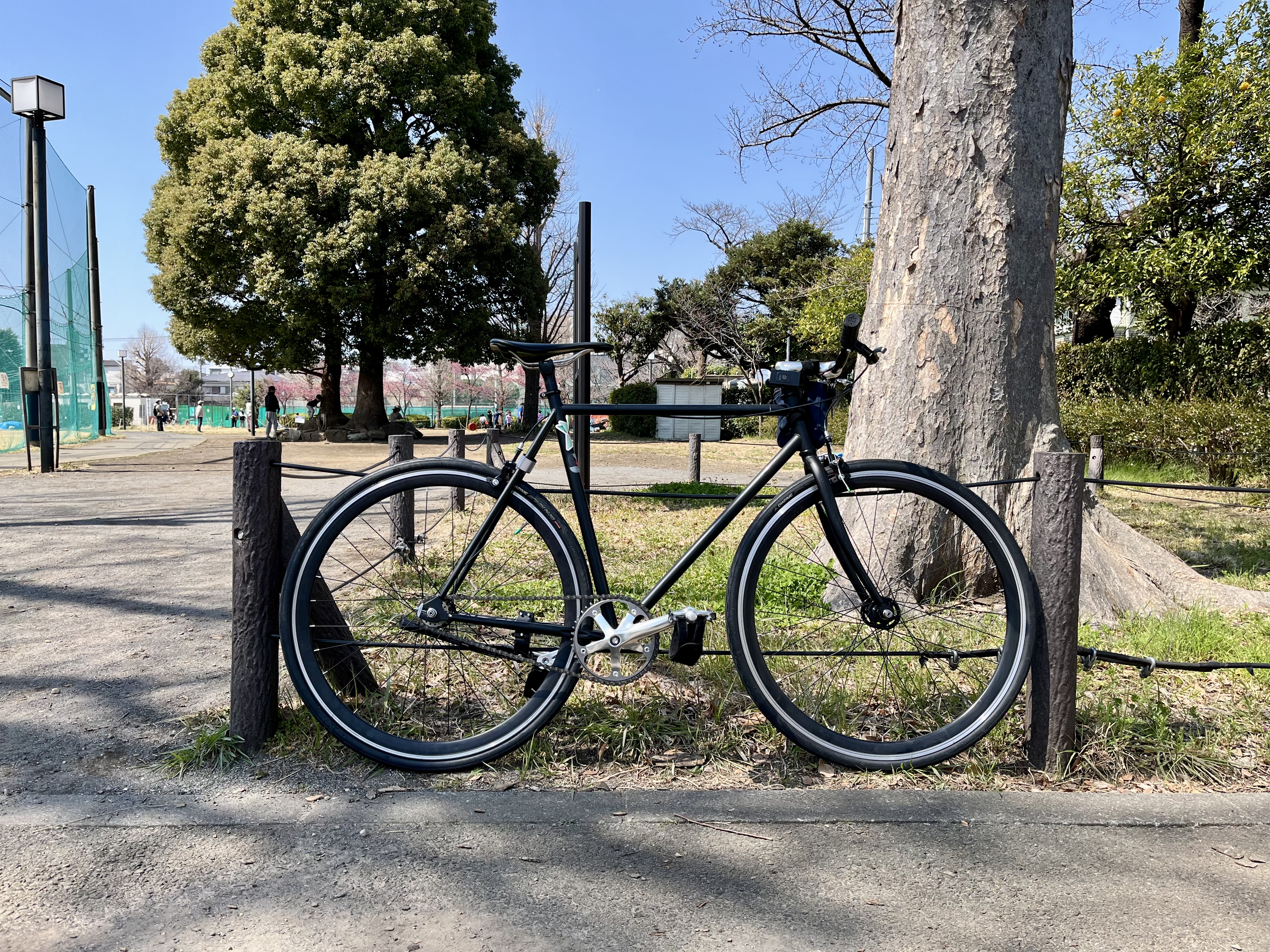
I added Ethereum and Ruby stickers, shortened the brake wire, and made small customizations such as valve caps, brake end caps, grips, and NJS chain tensioners. I have not changed the wheels because they are expensive and I prefer not to buy used wheels.
Among the complete-bike parts, the frame, BB, crank, and wheels were not bad. Gears, handlebar, seatpost, and saddle felt more cost-controlled, and changing them changed the ride significantly.
The BB and crank changed after replacement because the new parts were higher performance. The gears, handlebar, seatpost, and saddle felt like the parts where cheaper components were used to keep cost down. Changing those parts changed the ride quite a lot. If someone first considers customizing, these may be good places to start, though the appeal of piste bikes is that you can do whatever you like with all of it.
For me, the appeal of fixed gear can be summarized in three points: restoring bodily sensation through direct riding, the iterative trial-and-error of riding and customization, and expressing values beyond speed or convenience.