An update on product development with AI
About a year ago I wrote an article about product development with AI. There is one point that now seems to need an update, so I am adding this note.
In that article, I wrote that when introducing AI, it is very effective to start with a hybrid model between humans and AI. Looking at recent progress in AI, especially in coding, I now think that view needs to be revised. With the arrival of Claude Code, Gemini CLI, ROVO DEV, and similar tools, AI can now write code directly, and its code generation ability has improved substantially. The following workflow seems especially useful:
- Use a non-reasoning mode such as 4.1 to brainstorm ideas.
- Use a reasoning-focused AI such as o3 in a Q&A format to settle the specification.
- In the same context, have it generate prompts that split the work into tasks.
- Save the resulting specification and prompts as something like
Spec.md. - Give the split prompts, based on the document, to coding agents for implementation.
This workflow is based on the approach introduced in Harper Reed’s Blog.
Because this method specializes AI for writing code, it can make the most of AI’s code generation ability. If we extend the method further, the same approach may become useful not only for coding, but also for planning documents, scenario writing, and other domains. Seen this way, the human and AI hybrid model may not always be the best answer.
Research such as Future of Work with AI Agents is also advancing, and AI agents are likely to evolve in ways that complement human work. This will probably change approaches to product development with AI as well. The figure below seems especially useful as a reference.
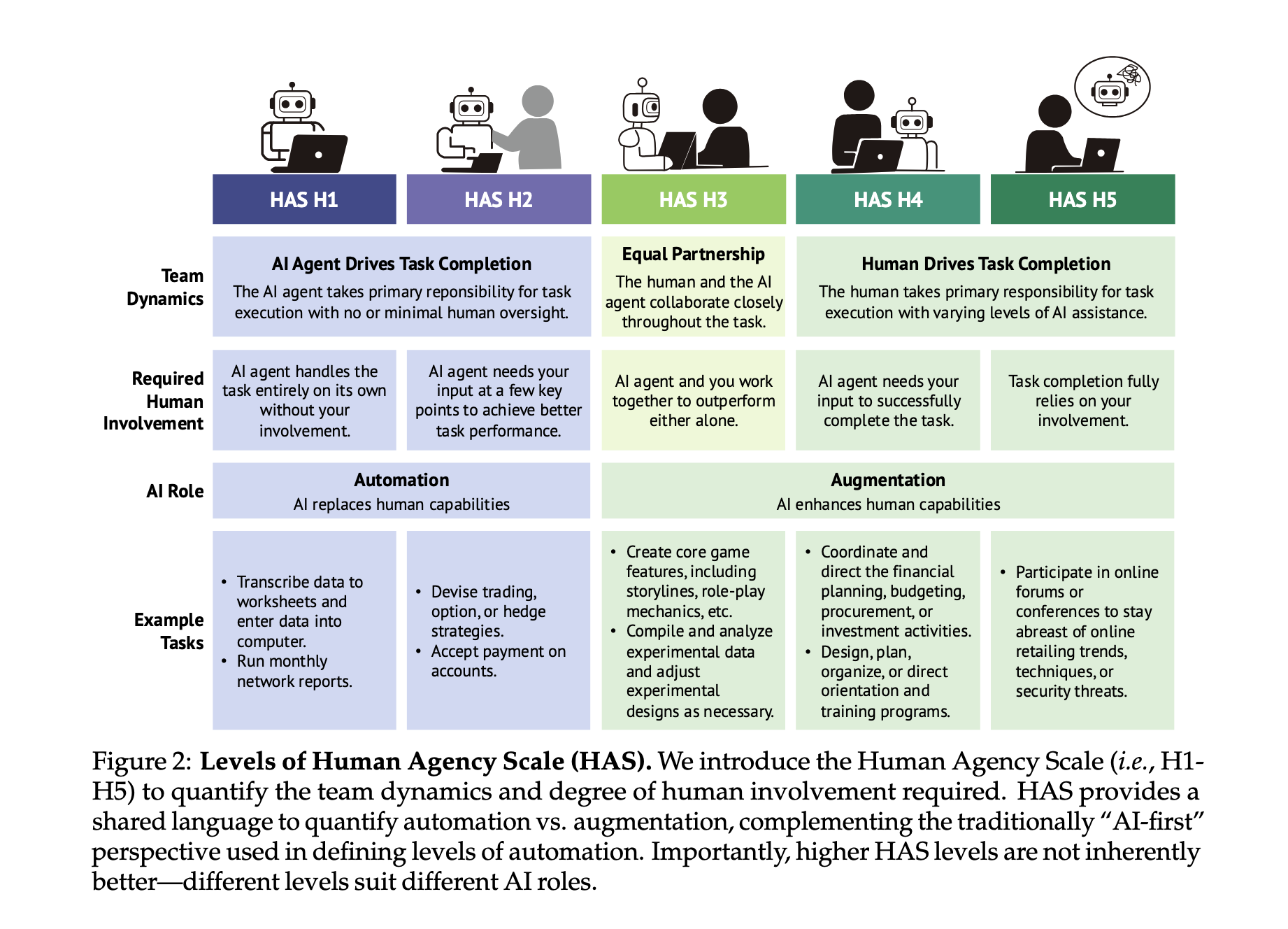
Many discussions tend to separate what AI is good at from what humans are good at. But if AI agents continue to evolve as complements to human work, the division of roles between AI and humans will become more flexible and more gradual. In that case, it seems more efficient to classify and review entire processes by level, assuming that range of possibilities.